
MYOPL NEWS
Every Pickleball Term You Need to Know: Speak the Language, Own the Court
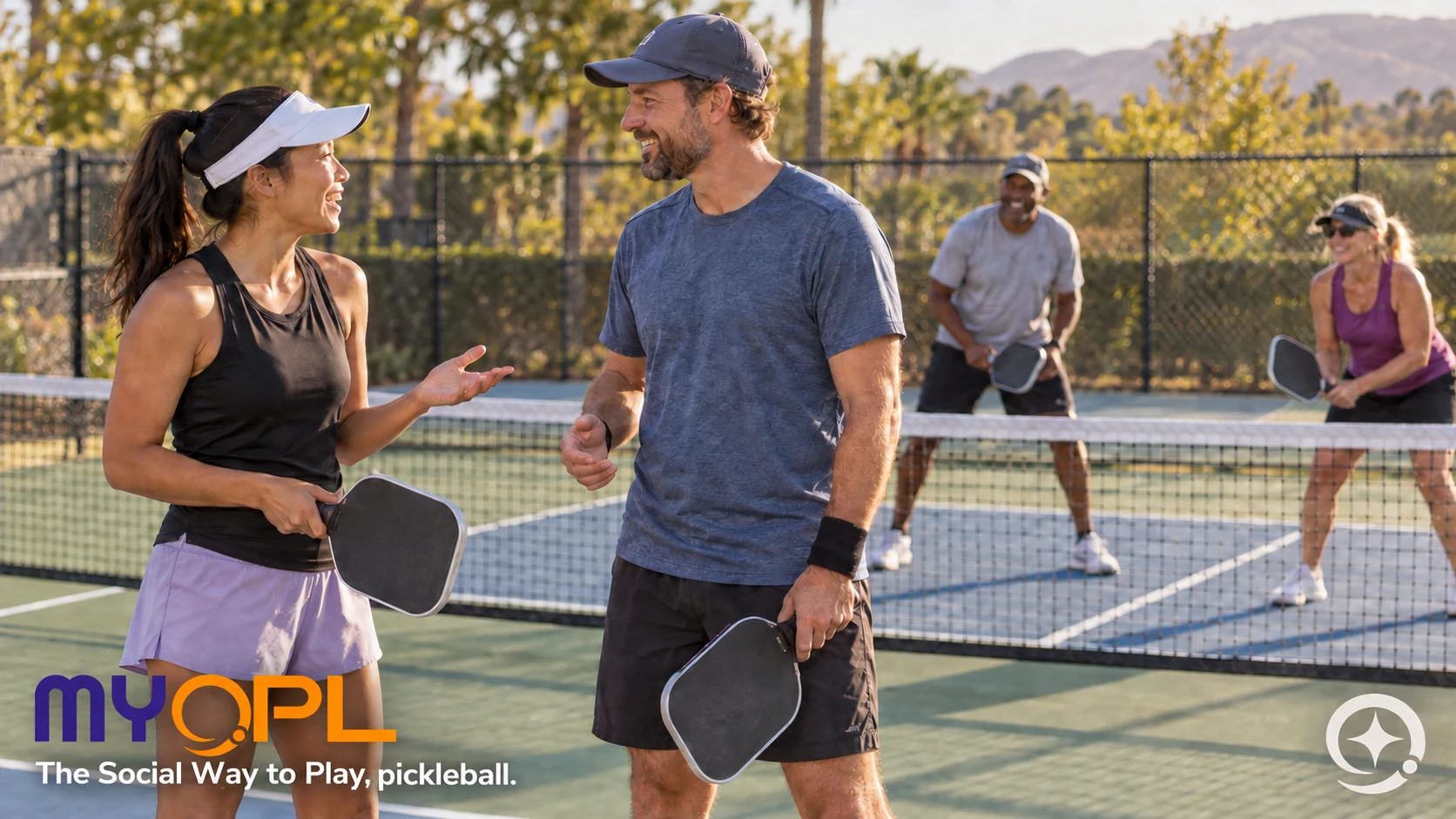
Every day, players step onto pickleball courts looking for the same thing: good games without an administrative headache. MYOPL (My Open Play Leagues, pronounced “My Opal”) helps people find open-play sessions, connect with nearby players, coordinate matches, record confirmed results, and track a recreational OPL Rating.
Before a player can own the court, it helps to speak the language. This plain-English pickleball glossary brings together the equipment, court lines, serving and scoring rules, shots, strategy, player calls, tournament conduct terms, and colorful slang heard during open play.
Rules note: Rule-sensitive definitions in this guide were checked against MYOPL’s validated copy of the 2026 USA Pickleball Official Rulebook. Informal slang varies among communities and is labeled accordingly. The official rulebook—not a glossary—controls sanctioned play.
Pickleball Equipment and Match Formats
A basic game needs paddles, a perforated plastic ball, a net, a marked court, and players. These are the first pickleball terms beginners need to know:
- Paddle: The solid piece of equipment used to strike the ball. In pickleball, it is called a paddle, not a racket.
- Ball: A lightweight, durable plastic ball with evenly spaced holes. Indoor and outdoor pickleballs may differ in hole size, number, weight, and material response.
- Doubles: The four-player format with two partners on each team. Doubles is the most common social and open-play format.
- Singles: One player against one player using the full court.
- Skinny Singles: A one-on-one practice or game variation that uses only half of the court—straight ahead or diagonally, depending on the chosen format—to rehearse doubles-style angles and movement.
Pickleball Court Lines and Rules
- The Kitchen (Non-Volley Zone or NVZ): The 7-foot-by-20-foot area next to the net on each end of the court. A player may enter it, but may not volley while touching the zone or its lines; momentum from a volley may not carry the player into it. See Rule 3.A.4.c and Section 11.
- Non-Volley Line: The line 7 feet from the net that marks the back edge of the kitchen. The line is part of the non-volley zone.
- Baseline: The back boundary line at each end of the court, parallel to and 22 feet from the net.
- Centerline: The line running from the non-volley line to the baseline that separates the right and left service courts.
- Sideline: Either outer boundary line running perpendicular to the net and baselines.
- Two-Bounce Rule (sometimes called the Double-Bounce Rule): The serve and the return of serve must each bounce before being returned. After those two required bounces, volleys are allowed. Do not confuse this with a double bounce, which occurs when the ball bounces twice on the same end before it is returned. See Rule 10.A.
- Plane of the Net: The vertical plane aligned with the net and extending above, below, and to both sides. A player cannot hit the ball before it entirely crosses to that player’s end; player movement across the plane is governed by the limited exceptions and faults in Rule 13.I.
- Permanent Object: An object on, above, or near the court that can interfere with play, such as a ceiling, wall, fence, light fixture, net post, bench, or spectator in a recognized position. The result of contact depends on when and where the ball hits it.
Pickleball Serving and Scoring Terms
- Serve: The initial strike of the ball that starts a rally. A legal serve is directed to the diagonally opposite service court and may be made as a volley serve or drop serve.
- Volley Serve: A serve in which the released ball is struck before it bounces. At contact, the paddle must move in a clear upward arc, the paddle head must not be above the wrist joint, and the ball must be no higher than the server’s waist. See Rules 7.C.1–7.C.3.
- Server Number: In standard doubles scoring, the final number in the three-number score call—1 or 2—identifies whether the first or second partner in that service sequence is serving. Games begin at 0-0-2.
- Side-Out Scoring: Standard scoring in which only the serving player or team scores a point by winning a rally. A side out awards the serve to the opponent after a singles player or doubles team loses its service turn. The 2026 rules also include a provisional rally-scoring option.
- Ace: An informal term for a legal serve that wins the rally immediately, often because the receiver does not touch it.
- Foot Fault: A fault caused by illegal foot placement, such as violating the serving-area requirements at contact or touching the non-volley zone while volleying.
- Line Call: An audible or visual signal that a ball did not land in the required court area. Players make calls according to the line-calling responsibilities and certainty standard in Section 8.
Pickleball Shots and Strategy
- Dink Shot: A soft, controlled shot intended to clear the net and land in the opponent’s kitchen, making an aggressive return difficult.
- Cross-Court Dink: A dink played diagonally into the opponent’s kitchen, using the longer diagonal distance and a sharper angle.
- Third Shot Drop / Third Shot Drive: The serving team’s first shot after the return of serve. A third-shot drop lands softly in the kitchen to support a move forward; a third-shot drive uses pace to pressure the opponents or create a later transition opportunity.
- Approach Shot: A groundstroke hit while advancing toward the non-volley line, intended to support a safe transition from the baseline.
- Punch: A compact volley with little backswing, using a short forward motion to redirect or accelerate the ball.
- Lob: A high-arcing offensive or defensive shot sent over the opponents toward the baseline to move them away from the net.
- Half Volley: A shot played immediately after the ball bounces and before it rises to its peak.
- Put Away: A decisive attacking shot hit with enough placement, angle, or pace to end the rally.
- Backspin (Slice): Reverse rotation that can make the ball float, stay low, or skid after the bounce; it is commonly produced by brushing from high to low through contact.
- Topspin (Top Spin): Forward rotation commonly produced with a low-to-high swing, helping the ball dip into the court and kick upward after the bounce.
- Poach: In doubles, a deliberate move across the middle by one partner to intercept a ball that might otherwise be played by the other partner.
- Slammers: Informal slang for players who rely heavily on power and pace instead of dinks, resets, and other soft-game choices.
Common Pickleball Court Calls and Communication
- “Bounce it!”: A teammate’s call asking a partner not to volley an incoming ball because it may land out. The player nearest the ball still makes the play decision.
- “OPA!”: An informal call used by some groups after the return of serve has bounced and the third shot is played, signaling that the two required bounces have occurred and volleys are now available.
- “Nice get!”: Praise for reaching and returning a difficult ball.
- “Nice setup”: Recognition that a partner’s placement or pressure produced a weak reply and created the next attack.
- “Nice rally”: Respectful acknowledgment of a long, skillful, or entertaining exchange.
- Dead Ball: An official term for a ball that is no longer in play. A rally ends when a rule, fault, or other event makes the ball dead.
Pickleball Tournament and Conduct Terms
- Verbal Warning: A non-punitive caution for minor unsportsmanlike behavior, usually given before a technical warning or technical foul. Only one may be assessed to each singles player or doubles team per match.
- Technical Warning: A punitive warning for minor unsportsmanlike action or behavior. It is formally assessed but does not change the rally result or point total.
- Ejection: Removal of a player from tournament competition for a flagrant or injurious behavioral violation.
- Profanity: Words, phrases, or gestures commonly considered vulgar or inappropriate in public or around children. Audible or visual profanity can result in a warning under Rule 22.
- Retirement: A singles player’s or doubles team’s decision to stop playing a match already in progress. The match is awarded to the opponent.
Pickleball Slang and Court Lingo
These playful expressions are not official rulebook terms, and their meaning or popularity can vary by region and playing group:
- Falafel: Informal slang for a weak shot—often an edge hit or mishit—that falls short without much pace.
- Flapjack: An uncommon nickname for a ball that must bounce before it can be returned under the two-bounce rule, especially the serve or return of serve.
- “Pickle!”: A casual readiness call some servers use before serving. It is not a required official call and should not replace the score call.
- Pickled: Informal shorthand for losing a completed game without scoring, such as 11-0.
- Pickledome: A playful nickname for a marquee show court, championship court, or pickleball-focused venue; it is not an official court classification.
- Pickler: An enthusiastic, dedicated pickleball player.
- Volley Llama: A humorous nickname for a player who commits a non-volley-zone fault by volleying while touching the kitchen or its boundary.
Speak the Language, Then Step onto the Court with MYOPL
Knowing pickleball terminology builds confidence. Using it during real play builds court awareness, clearer communication, and stronger partnerships. MYOPL gives recreational players a shared place to discover Courts and Clubs, join Open Play Leagues, coordinate sessions, and record completed results that can contribute to an OPL Rating after confirmation.
Create your MYOPL profile, find an open-play community near you, and make your next game count.
About MYOPL: MYOPL (My Open Play Leagues), independently developed by StreetLoc Inc., is a social sports platform for recreational pickleball. MYOPL helps players find communities, coordinate open play, communicate, record confirmed results, and track an OPL Rating built for everyday play.
Frequently asked questions
What are the most important pickleball terms for a beginner?
Start with paddle, serve, kitchen or non-volley zone, dink, volley, two-bounce rule, side out, doubles, baseline, and line call. Those terms explain the equipment, court, scoring, and basic rally rules a new player encounters first.
What is the kitchen in pickleball?
The kitchen is the informal name for the non-volley zone: the 7-foot-by-20-foot area next to the net on each end of the court. A player may stand in the zone, but may not volley while touching it or its boundary lines, and volley momentum may not carry the player into it.
What is the two-bounce rule in pickleball?
The serve must bounce before the receiving team returns it, and the return of serve must bounce before the serving team returns it. After those two required bounces, either team may volley a legal ball. This is different from a double-bounce fault, when the ball bounces twice on the same end before it is returned.
What does 0-0-2 mean in doubles pickleball?
In standard side-out doubles scoring, the three numbers are the serving team’s score, the receiving team’s score, and the server number. Zero-zero-two identifies the starting score and reminds players that the opening team begins with only one server before the first side out.
Are terms such as falafel, flapjack, pickled, and volley llama official rules?
No. They are informal pickleball slang, and usage can vary by region or playing group. Official rules terms and numbered rules control play; slang is included here so players can recognize common court conversation.